
“Dear Lord… Thank you for guiding me straight and true through the many obstacles in my path…”
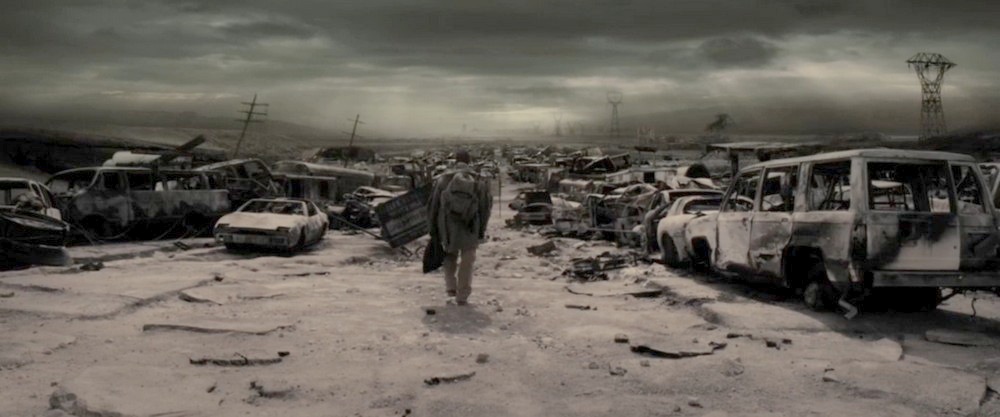
The Book of Eli was my favorite film in January 2010, though considering this is usually the month where movies go to die (save for the occasional horror film, so if a film is “undead” it’s okay) Eli didn’t have stiff competition. However, I was desperate to see this movie for an atypical reason:
My wife got an advance copy of the screenplay over a year ago from a friend and was struck by its unerring Christian center. She summarized it for me, from awesome apocalyptic beginning to its shock-peppered ending, and I was surprised. We both agreed there was NO way this screenplay would ever get made. When we heard it was in production, and starring Denzel Washington and Gary Oldman, we were blown away… yet determinedly pessimistic. We altered our tune, certain there was NO way it would ever survive with all the biblical elements intact.
We were (happily) mistaken. Not only have The Hughes Brothers made a thoroughly enjoyable film, they maintained it’s spirit and even surprised me with the casting of Denzel as a very quiet, deliberate action hero. (click here for the trailer)
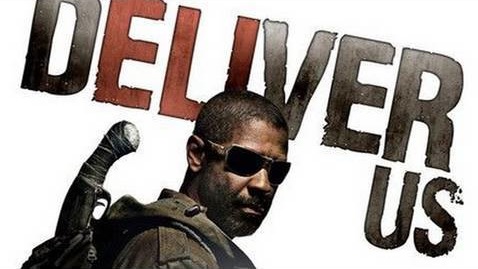 A lot of people don’t know what to do with Eli. Secular critics have lambasted it from various angles, though dancing around its ultimately pro-Bible, pro-God message. Fundamentalist Christians aren’t sure what to do with the violence and profanity. To me, this gives the movie a fascinating tension that cuts right down the middle, as sharp and unrelenting as the character of Eli slices through the profane and maintains the importance of God’s guidance and Word.
The film seems to have had 3 obvious, notable stylistic influences:
1. Bleak future reminiscent of B-grade 80s apocalyptic films (but with the budget and effects they always wanted).
2. Solitary avenger evoking shades of Clint Eastwood’s classic spaghetti-western “man with no name”.
3. “Future-western” feel with guns, swords and martial arts feels like a live action anime (Trigun?)
It’s not much of a spoiler to say we learn pretty early on that the solitary Eli is headed west, carrying what he believes is the last King James Bible, convinced he is being led by God. He crosses paths with depraved robbers, local power-grabbing tyrants, and the rare person who still seems to have anything resembling the “milk of human kindness”. It may not be as depressing as The Road, but the film has a gravity and weight between action sequences that is palpable. I’m also hard pressed to think of a film – other than one you’d find at some cheesy Christian bookstore – with more scripture quoted than The Book of Eli. That element alone made the film, and it’s cultural placement, unique and fascinating to see and hear.
 Some Christians might complain about a few scripted lines, such as one where Eli explains most copies of the Bible were burned because some claimed it was “the cause” of the apocalyptic war. In a culture like ours that frequently wants to blame all war on religion, I think this is simply a fair assessment and a likely reality that would occur; it’s not the film speaking against the Bible so much as simply noting our blame-shifting and fear. Another beat in the film’s narrative drum does deal with other religious books – something Christian critics may point out as pluralistic – but the reality is the centrality and weight of the Bible in the film is still evident, and the question of God’s presence in Eli’s life makes the film’s focus fairly obvious.
Suffice to say, The Book of Eli is now one of my favorite post-apocalyptic films. Although the obvious theme of the Bible’s importance is carried – literally – throughout the story, the film also has key points to make about man, religion, and God that we’ll discuss in the second part (click here).
Until then: what are YOUR favorite post-apocalyptic films… and WHY?
Update: audio review of The Book of Eli also available
Read an interview with Gary Witta, the screenwriter. He spoke about his sit-down with Denzel, who had the right to give notes. He said that although the studio was hot and heavy to tune down or elminate the religious elements, Denzel not only refused to have any of them removed, but whipped out his Bible and went over the script line by line with him!
I hope it comes to The Crest.
i remember leaving the theater after seeing this movie and saying “that is a very rare movie.” as someone going into the film industry it was inspirational to see a movie that could keep its christian message without being watered down by some paranoid producer. it truly is rare in that sense.
this movie gives me hope that hollywood can be used to spread the gospel. many christians dont believe hollywood has any use and we need to start our own industry. this is where you find those corny christian movies made with two pennies. hollywood isnt afraid of spreading any message…as long as it turns a profiet. christian filmmakers just need to learn how to make their movies profitable for hollywood. like this movie did.
Rare indeed, Alex! Perhaps more hope, patience and persistence will be of lasting value than something that only shows up in a Christian stores feel-good pablum section! Take those two pennies and put them over the eyes of those corny “Christian” films, let them rest and encourage others to be missional that have artistic prowess and aspiration like yours. I’m glad Eli gave you hope in a very unique way.
[…] Seen the movie? Now read the BOOK (of Eli) […]
[…] Seen the movie? Now read the BOOK (of Eli) […]
i just finished watching this movie. It was inspiring, convicting, beautiful, action packed, intelligent, and very well produced. Thank you Jesus. God can use even non-christian hollywood to get His gospel out.
It was absolutely wonderful and inspiring to see this movie. What a glorious thing it is when God’s Gospel is proclaimed missionally through Hollywood. We need more of that!
Some of my favorite Post Apocalyptic films of all time would be the Mad Max series….I haven’t watched them recently the way that I think and analyze movies now. I think they would have similar or exact elements that the Book of Eli had at least with showing the depravity of man and the extent what man goes to to survive, get what they want, struggle for power etc. Those are very simple and superficial themes but important none the less. Also, the Book of Eli resembled the game Fallout 3 with at least atmosphere and also the games S.T.A.L.K.E.R at least as far as atmosphere goes with a very barren and desolate place and even where you find life and “safety” there is still death and darkness surrounding you…no where truely feels safe. Also Fallout 3 is filled with reminscents of old sci-fi movies and its awesome!
[…] movie and the centrality of the Bible are almost shocking for a Hollywood movie. James Harleman at cinemagogue.com […]
[…] you anywhere near Seattle? You’re welcome to join us Friday in NE Seattle for a viewing of The Book of Eli in its entirety, followed by exposition and discussion. In fact, no matter where you are, you can […]
[…] now, Inception and The Book of Eli are battling in my mind for best film of the year. We’ve already visited the post-apocalyptic […]