
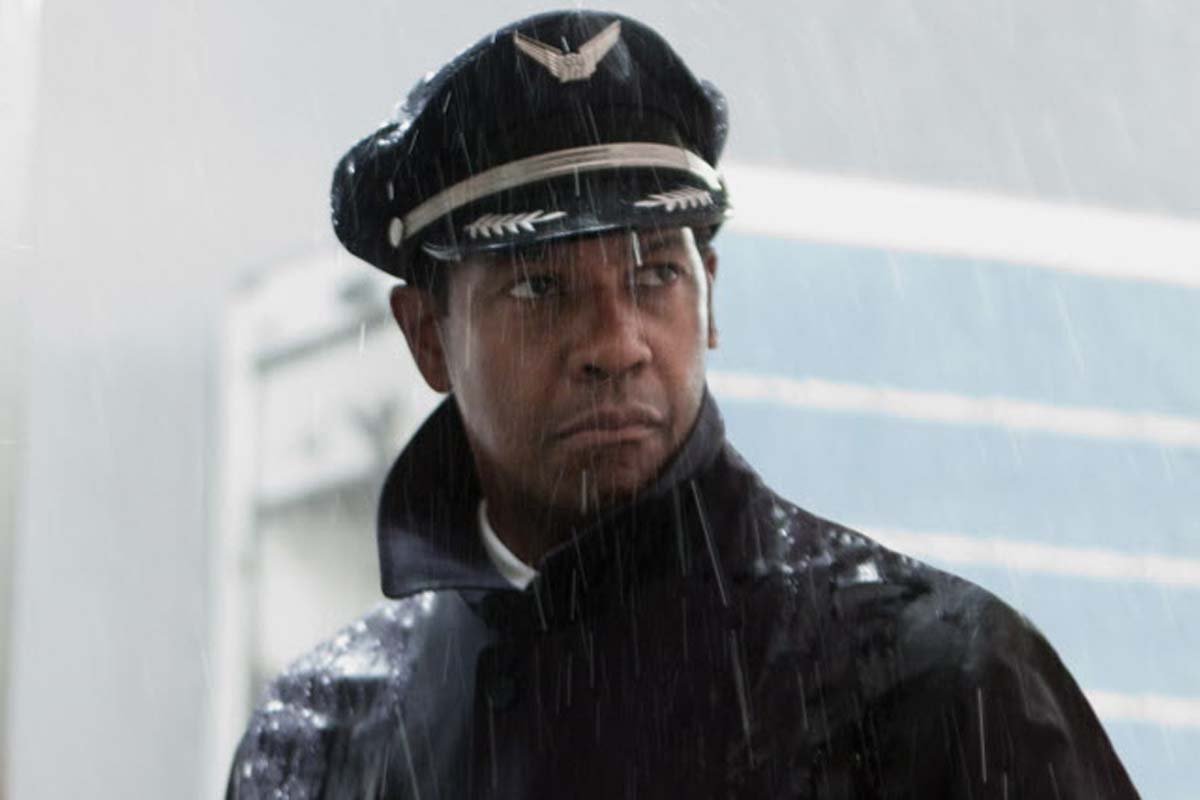
It’s always Act 3 when the misunderstood, flawed-but-redeemable protagonist saves the day, right?
 We think we know the formula backward and forward, whether it’s Tony Stark or Indiana Jones, John McClane or John Creasy. Despite the vices and hubris, the lives they’ve damaged emotionally or physically, the mixed motivations they have throughout the story, we know that in that final act – some decisive moment approaching the climax – these characters will prove their worth with some amazing feat that lets us pave over a multitude of seemingly smaller sins. What’s refreshing about Robert Zemeckis’ gut-wrenching film starring Denzel Washington is that, like the airplane in the film, this narrative formula is turned upside down.
What might be a climax in many movies becomes the opening sequence in Flight, and after the unprecedented crash landing wherein Whip Whitaker saves over a hundred lives, the rest of the film shows us that the story is about how, despite this, the world of our protagonist just keeps on crashing.
“Nobody could’ve landed that plane like I did.”
Whip Whitaker (Denzel Washington) has been surviving on charm, booze, and cocaine as a functioning alchoholic for God knows how long, and despite the fact that he didn’t cause the crash (and indeed saved countless lives with a radical, unrepeatable maneuver) the drug test taken at the hospital and lives he has wrecked or sullied to maintain his lifestyle begin to get exposed. It’s a reminder to the thoughtful viewer: how many “heroes” in stories have we let off the hook for abuses because they do some amazing act? Even though what these characters do rarely directly addresses the multitude of wrongs, we give them a pass because they did one act of heroism or just something impressive to behold.
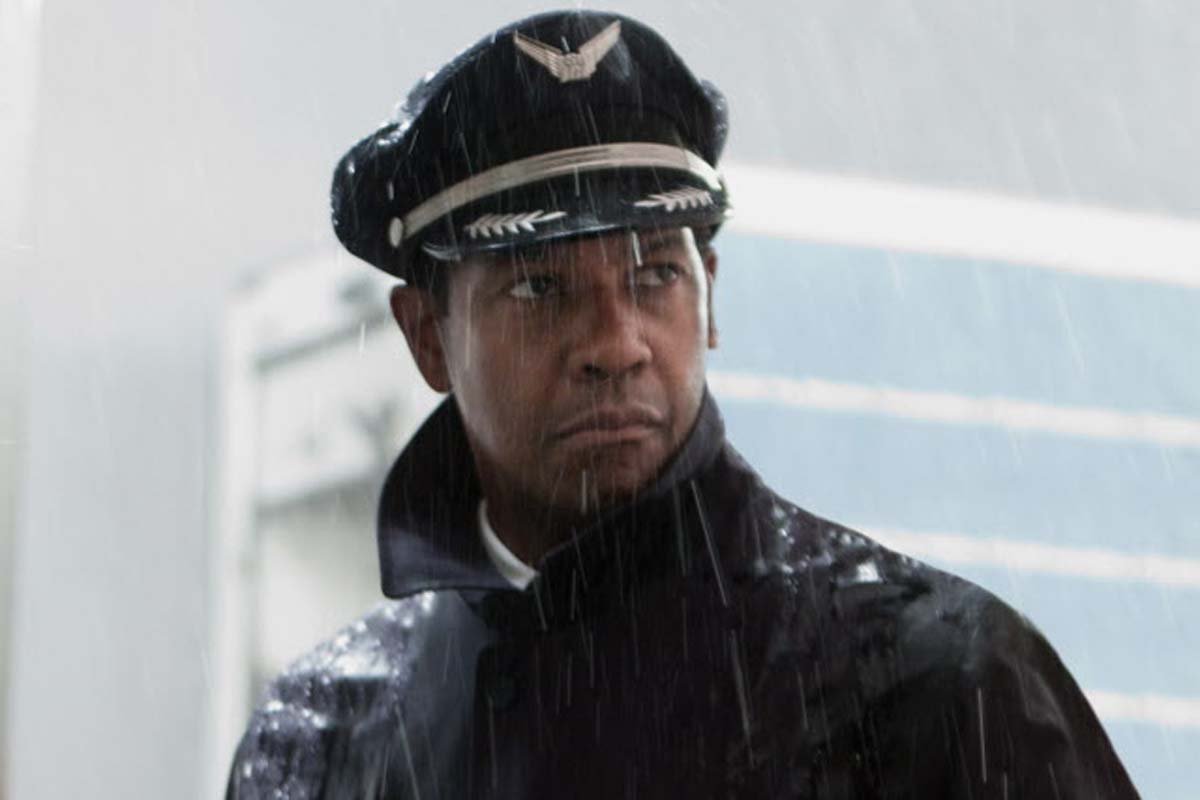 One might even suggest Whitaker’s state of “enhanced” mind is part of what allowed him to consider and complete the life-saving maneuver with the plane. Is it fair, then, that he face the technicalities and pay the price for his other wrong-doing? A God-fearing person might even believe that he was used at that time in that place – even in that state – to be an instrument of imminent salvation for the passengers of the flight. Again, does being used by God for something good mean Whip should be absolved of his other sins?
King David may have slain Goliath, but that doesn’t get him off the hook for adultery. Or murder.
While we may not have something so extreme in our lives as this event, the truth is we all probably try to apply the same “creative math” to our own meritorious absolution in life. We have habits, vices, sins we think we can “manage”, and we count the other things we do – the servant moments or heroic gestures – as a form of scale balancing. We think we deserve a pass on our sins “over there” because we did something good “over here”. We want everybody’s attention in one direction so they overlook the other. And so it goes:
“…watch yourselves lest your hearts be weighed down with dissipation and drunkenness and cares of this life, and that day come upon you suddenly like a trap. – Luke 21:34
It’s too easy for us to look at a film dealing with alcoholism and substance abuse, to see Whip Whitaker ‘s world crumbling around him, and count ourselves lucky “we don’t do drugs” or drink too much. It’s too easy to say it’s a great film about “that kind” of problem and let ourselves off the hook, to miss the very applicable reality to our own life. Flight is not a film about the dangerous life of an alcoholic, it’s about a man who is mastered by the material, enslaved to his desires, shackled to a craving and affection that has no lasting value. This could be anything – sex, food, an unhealthy relationship– and not one of us can say we’re immune.
“‘Everything is permissible for me’–but not everything is beneficial. ‘Everything is permissible for me’–but I will not be mastered by anything.” – 1 Corinthians 6:12
 A cancer patient at the hospital tells Whip that everything happens for a reason – that God has a plan – and the film actually bears this out to be true. The airplane incident starts picking at the scab of his deeper problem, exposing it to the world. His relationship with another substance abuser actually helps her to acknowledge and overcome her own problem, seeing a vice-filled future by looking at Whip. Yet again, Whitaker’s ills seem to be “used” in a backward sort of way to yield a good result.
It’s also curious to witness how all the other human characters – for their own reasons – simply help manage, hide, or whitewash the problem to their own benefit. Whether it’s the lawyer, the union representative, or Whip’s vice-supplier Harling Mays, they all have compromised motives. Indeed, Harling – played with verve by John Goodman – is a virtual serpent whispering in Whitaker’s ear: assuring him that he’s justified, deserving, and promising to take good care of him. It’s appropriate that he’s so charismatic and compelling to watch on screen, as befitting the tempter. Almost no one is concerned with Whip’s redemption… but then there is an unlocked door, a breeze through an open window, and an opportunity… a hard to argue, unseen hand forcing Whip to a precipice, and a decision.
 “This thing is so heavy it’s killed me.”
As Whitaker finally whimpers “God help me…” we see the film very strongly – if not definitively – points out this is providence and not coincidence. If Whip Whitaker is going to be convicted, if he’s going to confess – if he’s going to face who he really is – we are shown this will not occur by human hands.
“…you have been saved through faith. And this is not your own doing; it is the gift of God, not a result of works, so that no one may boast.” – Ephesians 2:8-9
As a Christian, I almost found the themes so overt that I wondered if it played well to those who don’t believe in God… who don’t place hope in the things implied so heavily in the film. For pity’s sake, the crash basically comes down at the doorstep of a church, just past the baptismal pond. Still, I hope this particular Flight still provides some questions for everyone to ponder.
-
What masters YOU? Are you getting through life propped up by earthly vices?
-
Do we use good deeds to mentally absolve ourselves of the various, assorted and sundry wrongs we do?
-
Have we shifted blame for our own self-image, thinking it didn’t really matter or hurt others?
-
Is there a hand of providence at work to thwart our self-deception and make us face who we really are?
-
Will we continue to shift blame, or cry out for help from one who saves?
This was excellent. Just saw the movie last night and actually got to talk with a couple Christians who at first thought it was bad because of all the drugs and booze. Nevertheless, when we were talking they admitted that it made THEM feel bad, and hated what he was doing, and so I was able to show them that that’s exactly the point: a life full of sin is not something easy to watch.
While I do understand that the whole naked scene was there (in part) so that Trina is either ‘redeemed’ as a character (if he confesses), or destroyed if he blames it on her (as all she would be was a naked drunkard), I completely hated that. It forced me not to write about the movie, nor recommended to others. What do you think about that?
As I mention in the book, I’m not an advocate for nudity in movies as it’s the one thing you can’t write off as simulated (unlike violence, verbal or physical, which is all staged). Naked it naked. Still, there are ways that nudity (or just scantily clad actors) can be used to titillate and tempt going into a sexual situation, and then there are moments (after, the next morning) that can be used to accentuate awkwardness and being so messed up, like talking to the ex while the mistress is present.
It’s simple today, even on websites like IMDB that don’t purport to be Christian, to find a helpful list of rating content and I heartily recommend that. I wouldn’t recommend people go into this or any film ignorant of that, but recommend they use conscience, eyelids, etc. to keep hearts and minds in check including abstinence as needed. Lots of things may be permissible but not everything is beneficial, and to some degree this will vary with individuals.
I completely understand and agree with that. The reason why I can’t write is because my pastors asked me not to review film with this kind of content, since I’m the senior pastor assistant. I honor that, even though I’ve discussed the film with a couple friends, and the pastor himself.
Also loved what you wrote on the book. I also liked the way they showed his other partner, and the way they showed *nudity*, in that she was not dishonored by it (as a human, not actress), yet we know what they did. What I was wondering is, do you think this particular scene was helpful? Do you think that SPOILER – it was there so Trina was either the naked girl or the girl who saved the boy? Do you think it added to the story? Or was it just a manifestation that even Zemeckis is flawed?
It definitely added SOMETHING to the story…
To the point, I do NOT think it was essential to the narrative, and I think she could have been in a state of redressing and still got the point across. I can understand how, in a hyper-visual culture, a director like Zemeckis could see this as an effective way to literally put Whip’s weaknesses “in our face”, and establish the initial view of her as an object and not a person. But this also could have simply been established by having her height keep her face out of view, reducing her to a “body” instead of a person.
So… it may indeed help amplify the point, but “effective” and “beneficial” are not always synonyms. If, for instance, someone had told him he couldn’t show that much, I’ll bet his directing skills could have conjured up a less revealing but perhaps even more potent way of emphasizing this. Sometimes creative constraints produce something even more impactful because they make directors think beyond the easiest way of expressing a point, and creativity enhances it more than they first imagined.